ACO Structure & Governance

Accountable Care Organization Structure and Governance includes the formation of legal entities, leadership positions, committees, communication channels, and associated policies and procedures.

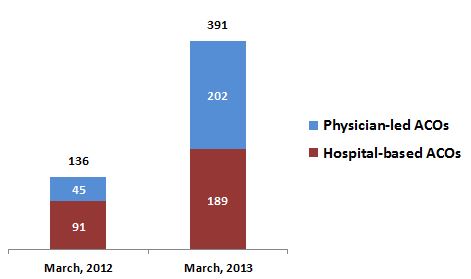
Physician-led ACOs now outnumber Hospital-based ACOs: Why this makes sense, and where our terminology breaks down.

At a recent meeting of the American College of Physicians covered in MedPage Today, Neil Kirschner, PhD reported on the growth of ACOs. Dr. Kirschner is the ACP’s senior associate of regulatory and insurer affairs. He reported that in March, 2012, there were only 136 ACOs  that had ACO-style gain-sharing contracts with Medicare, a commercial payer

Physician-led ACOs now outnumber Hospital-based ACOs: Why this makes sense, and where our terminology breaks down. Read More »

Of 27 new ACOs named by CMS: 93% avoid downside risk, 82% avoid CMS loans, 33% use payer-based infrastructure, and average beneficiaries per physician is 106

Yesterday, CMS announced the first batch of 27 “normal” ACOs under its Medicare Shared Savings Program (MSSP). I found five things interesting about the list: 93% were unwilling to accept downside risk.  In the original proposed rule for the MSSP, ACOs would have been forced to accept downside risk.  Presumably, CMS thought that “skin in

Of 27 new ACOs named by CMS: 93% avoid downside risk, 82% avoid CMS loans, 33% use payer-based infrastructure, and average beneficiaries per physician is 106 Read More »

What can we learn from the managed care backlash of the 1990s? Can we avoid an ACO backlash?

Advocates of “accountable care organizations” (ACOs) are careful to avoid the terminology of “managed care,” which is widely viewed as a failed model from the 1980s and 1990s.  But, there are obvious similarities between ACOs and managed care.  Both involve an organization taking responsibility for the quality and cost of care for a defined population.

What can we learn from the managed care backlash of the 1990s? Can we avoid an ACO backlash? Read More »

Mayo and Cleveland Clinic are becoming franchisers. Maybe they should focus on primary care.

As described in a recent article in American Medical News, the Mayo Clinic and the Cleveland Clinic are both independently offering medium to large groups of specialist physicians an opportunity to use their esteemed brand names and a variety of other resources formerly only available to employed physicians.  In return, the group has to pay

Mayo and Cleveland Clinic are becoming franchisers. Maybe they should focus on primary care. Read More »

Health Care Heroes: Wilmer Rutt, MD – Adapting the R&D Concept to Health Care Provider Organizations

This morning, I read the results from a clinical trial of ovarian cancer screening in JAMA.  The trial showed that ovarian cancer screening was not effective in saving lives.  I was interested in the article because I was one of the investigators in that trial, which began in the early 1990s.  Henry Ford Health System

Health Care Heroes: Wilmer Rutt, MD – Adapting the R&D Concept to Health Care Provider Organizations Read More »

Dr. Ward’s Slides from AMGA ACO Learning Collaborative, Chicago, July 14, 2011

Presentation entitled “Developing the Economic Model for Success” from day 2 of the American Medical Group Association’s Accountable Care Organization Learning Collaborative, at the Swissotel in Chicago.  Attended by approximately 60 leaders of AMGA member physician organizations and other interested parties. Full page PDF format. Hand-out PDF format.

Dr. Ward’s Slides from AMGA ACO Learning Collaborative, Chicago, July 14, 2011 Read More »

Explaining alternative types of ACO structures: How do Co-Management arrangements and Hospitalists fit in?

All across the country, physicians and hospitals are talking to each other about creating new organizational structures to enable them to work together more effectively.  Some are trying to create Accountable Care Organizations (ACOs) or Organized Systems of Care (OSCs) to participate in the Medicare Shared Savings Program or similar programs being launched by commercial

Explaining alternative types of ACO structures: How do Co-Management arrangements and Hospitalists fit in? Read More »

ACOs must steer clear of anti-trust issues

What’s the problem? Accountable Care Organizations (ACOs) involve the creation of new entities that are intended to improve quality and efficiency of care.  But, experts in economics and anti-trust law worry that ACOs can have the unintended effect of reducing competition among health care providers, creating local monopolies that can drive up prices. In a

ACOs must steer clear of anti-trust issues Read More »

Why many clinical leaders prefer Registries to EHRs: Actively Structured Information

I went to the huge HIMSS’11 convention in Las Vegas a few weeks ago.  When visiting the bewildering number of vendor booths, I focused on a few key questions relevant to the challenges facing physicians and hospitals working to establish successful Accountable Care Organizations (ACOs): 1) What is the current state of clinical data exchange

Why many clinical leaders prefer Registries to EHRs: Actively Structured Information Read More »

Harold Miller’s Paper: How to Create Accountable Care Organizations

This is probably the single most useful reference regarding Accountable Care Organizations, outlining alternative ways of conceptualizing them and giving a balanced explanation of the pros and cons of alternative models, including structure and reimbursement.  David Share, MD, from BCBSM was involved, and the document uses BCBSM’s Physician Group Incentive Program as a case study.

Harold Miller’s Paper: How to Create Accountable Care Organizations Read More »