Provider-based Care Management

Provider Based Care Management includes care delivery processes involving physicians and ancillary professionals coordinating care and teaching and facilitation effective patient self-management and healthy behaviors, possibly in collaboration or coordination with care management services delivered through health plans, employers and care management companies.

Congressional Budget Office: Care management programs only work if care managers have face to face contact with patients and substantial interaction with physicians

This month, Lyle Nelson of the Congressional Budget Office (CBO) released a “working paper” summarizing the results of a decade of experience with 6 care management demonstration projects in the Medicare population.  These demonstrations included a total of 34 disease management or care coordination programs. All of the 34 care management programs were designed to reduce

Congressional Budget Office: Care management programs only work if care managers have face to face contact with patients and substantial interaction with physicians Read More »

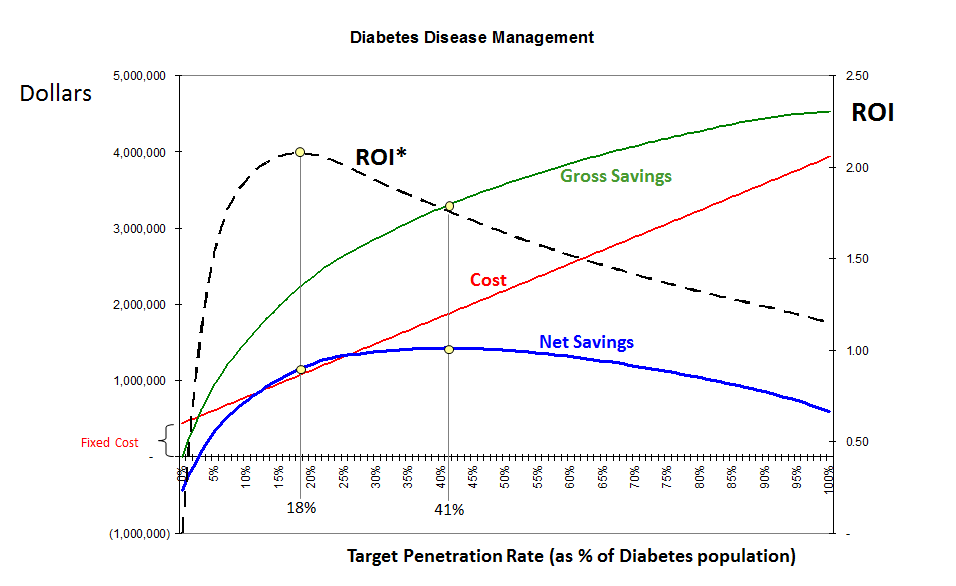
The debate about what to maximize when selecting candidates for care management programs: Accuracy? ROI? Net Savings? Or Cost-Effectiveness?

When doing analysis, it is really important to clarify up front what it is you are actually trying to figure out.  This sounds so obvious.  But, I am always amazed at how often sophisticated, eager analysts can zip past this important first step. Health plans, vendors and health care providers are all involved in the

The debate about what to maximize when selecting candidates for care management programs: Accuracy? ROI? Net Savings? Or Cost-Effectiveness? Read More »

Hospitalists have been focused on reducing hospital length of stay, but not so much on smooth transitions to ambulatory care

A new study published in the  Annals of Internal Medicine compared the economic outcomes of hospital episodes managed by hospitalists to those managed by the patients’ primary care physicians in a Medicare population. Previous studies focused only on the cost of the hospital stay itself, and showed that hospitalists were able to reduce length of stay

Hospitalists have been focused on reducing hospital length of stay, but not so much on smooth transitions to ambulatory care Read More »

Why “case load” is not a good metric for case management productivity or intensity

As shown in the following graphic recently published by the Healthcare Intelligence Network, it has become common practice to use “case load” as a metric for the productivity of nurses in case management programs or as a measure of the intensity of a case management intervention.  More broadly, case load has been used for these

Why “case load” is not a good metric for case management productivity or intensity Read More »

The Smoking Intervention Program, a Provider-based Care Management Process

Smoking cessation is an important public health concern, and has been the subject of a recent Agency for Health Care Policy and Research (AHCPR) guideline, as well as a HEDIS measure.   A point prevalence study conducted with the Henry Ford Health System found a 27.4% prevalence of smoking, and an additional 38.6% former smokers. The

The Smoking Intervention Program, a Provider-based Care Management Process Read More »

Implementation of Best Practices

The implementation of best practices to improve the quality and efficiency of health care involves making changes to both decision-making and care-delivery processes. The care management methods for improving these processes are largely borrowed from the work of Deming, Crosby, Juran, Ishikawa, and other practitioners of industrial process improvement. These methods are alternatively described as

Implementation of Best Practices Read More »