Continuous Quality Improvement (CQI)

A philosophy and methodology of management of production processes that emphasizes involving process experts, customers and front-line workings in identifying key quality characteristics (KQCs) , collecting and analyzing data regarding variation to understand the apparent cause-effect relationships between key process variables (KPVs) and KCCs, using small-scale, short-duration pilot tests of proposed process improvements, and then acting to hold the gains from successful improvements.

Trump/Musk killed AHRQ, but in a sense, the death has been playing out over 25 years. Recalling 4 eras of the agency and my dream for its eventual rebirth.

Slashing and Dissolving As reported by the Kaiser Family Foundation’s Health News site blog, last week the Trump administration “dissolved” the Agency for Healthcare Research and Quality (AHRQ), the agency that has for decades been at the center of the US Federal Government’s support for health services research in the service of improvement of our

Trump/Musk killed AHRQ, but in a sense, the death has been playing out over 25 years. Recalling 4 eras of the agency and my dream for its eventual rebirth. Read More »

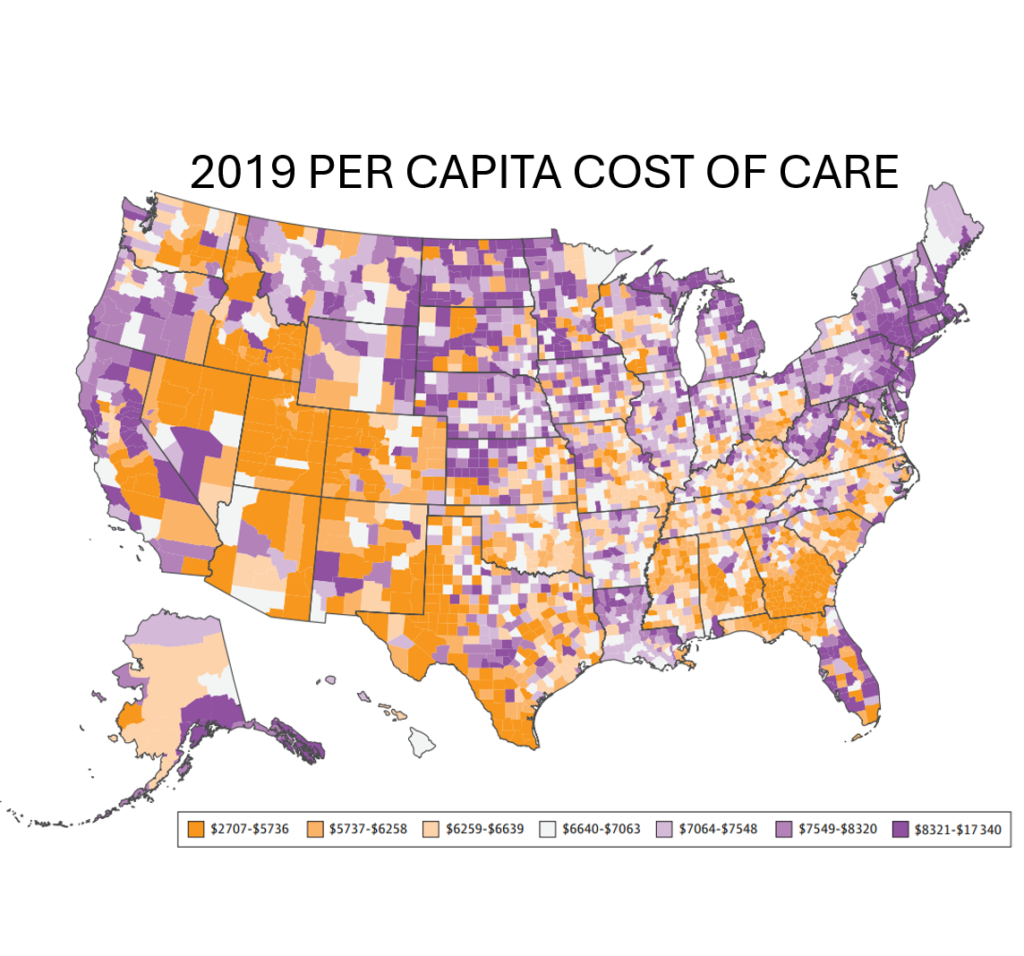
In the debate about price vs utilization as the main driver of geographic variation in cost of care, I say don’t get distracted from innovation.

I want to call your attention to a very thoughtful blog published by the semi-retired health care journalist, Merrill Goozner: the GoozNews Substack. Goozner’s most recent post, “It’s mostly overutilization, stupid” provides a delightful trip down memory lane, summarizing the decades-old debate about the causes of geographic variation in health care cost. Goozner started by

In the debate about price vs utilization as the main driver of geographic variation in cost of care, I say don’t get distracted from innovation. Read More »

Healthgrades page shown on iPad

What should we do when there is a clash between two noble goals: consumer transparency and quality improvement? Five proposed principles.

For many years, I’ve been following and writing blog posts about one of my heroes, Don Berwick, a physician leader, Obama-era CMS Administrator and one of most eloquent, persistent and effective advocates for quality improvement in health care. In a recent viewpoint article in JAMA, Dr. Berwick and two physician co-authors, Thom Meyer (from Duke)

What should we do when there is a clash between two noble goals: consumer transparency and quality improvement? Five proposed principles. Read More »

Berwick and Gilfillan offer six recommendations for reinventing CMMI. My response is yes, but they don’t address the #1 issue: failure to achieve critical mass.

In a recent health policy viewpoint article in JAMA, Drs. Don Berwick and Rick Gilfillan noted that, although the CMS Center for Medicare and Medicaid Innovation (CMMI) has done some good during its ten+ years of existence, it has failed to “become the engine that it could be for transforming the nation’s health care finance

Berwick and Gilfillan offer six recommendations for reinventing CMMI. My response is yes, but they don’t address the #1 issue: failure to achieve critical mass. Read More »

The Humunculus is a metaphor for Clinical Process Improvement Frameworks

During the last 20 years, we have experienced wave after wave of new frameworks for improving health care.  Each had its own terminology, ardently promoted and enforced by its zealous advocates.  Each had a lifecycle that began with a long incubation period, followed by a period of explosive growth in popularity and influence, rapidly leading

The Humunculus is a metaphor for Clinical Process Improvement Frameworks Read More »

The Smoking Intervention Program, a Provider-based Care Management Process

Smoking cessation is an important public health concern, and has been the subject of a recent Agency for Health Care Policy and Research (AHCPR) guideline, as well as a HEDIS measure.   A point prevalence study conducted with the Henry Ford Health System found a 27.4% prevalence of smoking, and an additional 38.6% former smokers. The

The Smoking Intervention Program, a Provider-based Care Management Process Read More »

Improving Total Hip Replacement Surgery

Background Joint replacement is a costly and frequently performed inpatient procedure.  In 1995, Henry Ford Hospital carried out 280 total hip replacements and 225 total knee replacements.  To decrease unnecessary inpatient utilization and enhance functional outcomes of joint replacement surgery, Henry Ford Hospital established a multi-disciplinary improvement team, including representatives from Orthopedic Surgery, Physical Therapy,

Improving Total Hip Replacement Surgery Read More »

Improving Adult Flu Immunization

Background The US Preventive Services Task Force established national evidence-based guidelines for adult immunization as part of their 1993 and 1996 review processes. After a review by Henry Ford Health System (HFHS) general internists, family practitioners, and infectious disease specialists, these guidelines were endorsed by the HFHS Prevention Committee. The Prevention Committee’s recommendations were subsequently

Improving Adult Flu Immunization Read More »

Necessary Elements of Care Management & Clinical Process Improvement Initiatives

A number of core elements are key to ensure the success of any care management or clinical process improvement initiative. As illustrated in the figure below, these elements include: conducting a preliminary needs assessment or problem identification; establishing an appropriate improvement team; defining the target population; identifying measurable goals and objectives; articulating the desirable decision

Necessary Elements of Care Management & Clinical Process Improvement Initiatives Read More »

The Managed Care College and Pediatric Asthma Management

The Managed Care College The Managed Care College is a comprehensive professional development program that is intended to go beyond the transfer of information. It attempts to persuade clinicians that change is necessary and desirable, to provide leadership and guidance in seeking change, to create opportunities to collaborate with colleagues in planning and implementing change,

The Managed Care College and Pediatric Asthma Management Read More »