Evaluation Methods

Evaluation Methods include methods for measuring and comparing the relevant outputs of one or more care processes or care providers to identify best practices, support equitable allocation of incentive resources, or support future decisions about network affiliation or referrals. These methods are borrowed and adapted from other fields, including epidemiology, biostatistics, econometrics and other social and physical sciences.

Coconut oil as an Alzheimer’s treatment? Please don’t short-circuit science.

My father recently forwarded an e-mail he received from a friend with a link to a TV news story about a physician who treated her own husband’s worsening Alzheimer’s disease with coconut oil.  My father is interested in the topic, particularly since he knows someone who suffered and died from the disease.  He forwarded the

Coconut oil as an Alzheimer’s treatment? Please don’t short-circuit science. Read More »

Congressional Budget Office: Care management programs only work if care managers have face to face contact with patients and substantial interaction with physicians

This month, Lyle Nelson of the Congressional Budget Office (CBO) released a “working paper” summarizing the results of a decade of experience with 6 care management demonstration projects in the Medicare population.  These demonstrations included a total of 34 disease management or care coordination programs. All of the 34 care management programs were designed to reduce

Congressional Budget Office: Care management programs only work if care managers have face to face contact with patients and substantial interaction with physicians Read More »

AHRQ guidance: Forget about proving Medical Home effectiveness with small pilot studies attempting to measure all-patient cost savings

The vast majority of already-published and currently-underway studies of the effectiveness of the Patient Centered Medical Home (PCMH) model of care are pilot studies with fewer than 50 PCMH practices.  Most of these studies report or intend to report reductions in hospitalization rates and savings across the entire population of patients served by the PCMH

AHRQ guidance: Forget about proving Medical Home effectiveness with small pilot studies attempting to measure all-patient cost savings Read More »

Telling a 46 year health care cost growth story in one graph

In a recent post to the Health Affairs Blog, Charles Roehrig, an economist who serves as VP and director of Altarum’s Center for Sustainable Health Spending, presented some very interesting graphics of long term health care cost growth in the U.S.  He shows the often-presented statistic of health care cost as a percent of Gross

Telling a 46 year health care cost growth story in one graph Read More »

So, is there any good use of O/E analysis? Yes. It’s called Benchmark Opportunity Analysis.

In last week’s post, I argued that observed over expected analysis (O/E) was commonly misused as a method for doing “level playing field” performance comparisons.  I recommend against using it for that purpose. But, is there some other good use for O/E analysis? I can’t think of a good use for the O/E ratio itself

So, is there any good use of O/E analysis? Yes. It’s called Benchmark Opportunity Analysis. Read More »

HHS Releases Final ACO Rule

The Department of Health & Human Services (HHS) today released the final rule for accountable care organizations (ACO). The new rule includes a number of changes designed to make the Medicare Shared Savings Program more palatable for health care providers who had a largely negative response to the draft rule released last March. The changes include the

HHS Releases Final ACO Rule Read More »

Observed over expected (O/E) analysis is commonly misapplied to performance comparisons. Please don’t.

A few years ago, I had a shocking and enlightening discussion about analytic methods with a group of epidemiologists and biostatisticians from Blue Cross Blue Shield of Michigan. We were sitting around a table at a conference center in Lansing, where we were debriefing from a meeting of the Physician Group Incentive Program. We were

Observed over expected (O/E) analysis is commonly misapplied to performance comparisons. Please don’t. Read More »

CMS Innovations Center announces new Medicare Bundled Payments Initiative. I predict it will be popular.

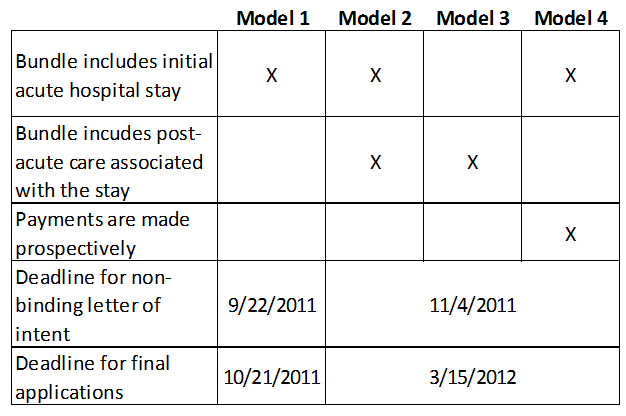
On top of the Medicare Shared Savings Program (the original ACO initiative) and the Pioneer ACO Program, CMS is now adding four more optional approaches for providers to get reimbursed for Medicare services.  The new models all involve bundled payments, where a single negotiated payment covers all professional and facility services for a particular type

CMS Innovations Center announces new Medicare Bundled Payments Initiative. I predict it will be popular. Read More »

Hospitalists have been focused on reducing hospital length of stay, but not so much on smooth transitions to ambulatory care

A new study published in the  Annals of Internal Medicine compared the economic outcomes of hospital episodes managed by hospitalists to those managed by the patients’ primary care physicians in a Medicare population. Previous studies focused only on the cost of the hospital stay itself, and showed that hospitalists were able to reduce length of stay

Hospitalists have been focused on reducing hospital length of stay, but not so much on smooth transitions to ambulatory care Read More »