Dr. Ward

Richard E. Ward, MD, MBA, CEO of Reward Health. Also physician, health care analytics and informatics innovator, husband, father, tenor & gradually improving swimmer

Hospital Value-based Purchasing program 1% incentive is like homeopathic medicine — too diluted to actually work

In the June 15, 2017 issue of the New England Journal of Medicine, Andrew Ryan and colleagues from the University of Michigan published an evaluation of the Medicare Hospital Value-Based Purchasing Program (HVBP). To summarize, if you offer a 1% incentive, and then dilute it by offering it only for the 40% of hospital patients

Hospital Value-based Purchasing program 1% incentive is like homeopathic medicine — too diluted to actually work Read More »

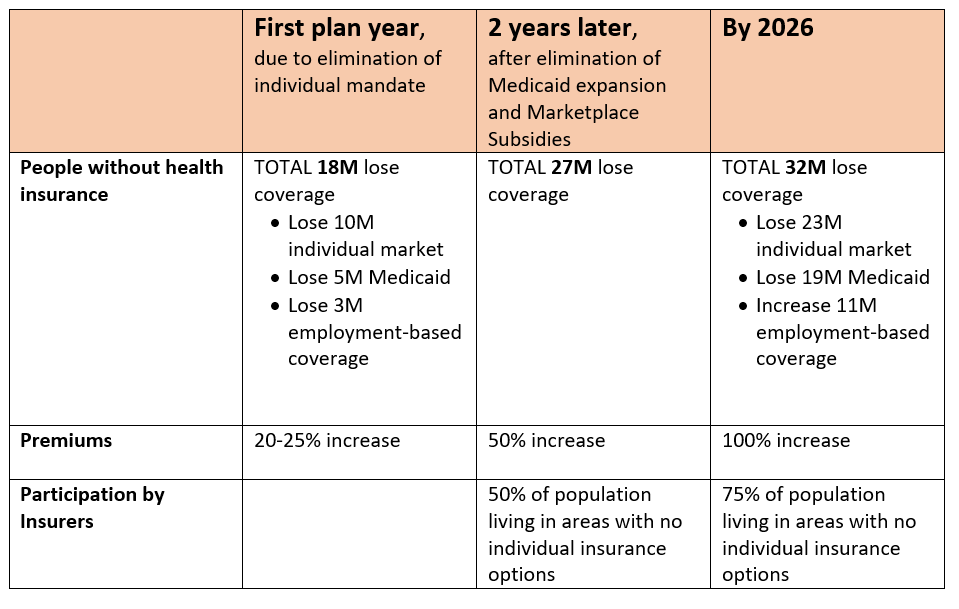
Congressional Budget Office: 27 million will lose coverage and premiums will increase by 50% if repeal ACA without replacement

In my last post, I noted that Congress was eager to repeal Obamacare, but lacked consensus on a replacement.  I noted that Obamacare was designed to cover the sick people and keep premiums affordable through the individual mandate and subsidies.  These two provisions of Obamacare can be reversed through legislative mechanisms that avoid filibusters.  But, removing

Congressional Budget Office: 27 million will lose coverage and premiums will increase by 50% if repeal ACA without replacement Read More »

Are high risk pools really a good replacement for Obamacare architecture?

Congress and the president-elect are enthusiastic about repealing Obamacare, but have not yet achieved any consensus about what to replace it with.  High risk pools figure prominently in various proposals, including Ryan’s “A Better Way” proposal.  But high risk pools are not a new idea.  Thirty five states had them in the years before Obamacare,

Are high risk pools really a good replacement for Obamacare architecture? Read More »

Three ways to keep it simple — one of which is bad

“Keep it simple, stupid.”   The “K.I.S.S.” principle.  Generally a good idea, but not always. Consider three types of simplification: Leaning.  This is about getting rid of waste. When simplifying a design, leaning involves getting rid of unnecessary features.  When simplifying communications, leaning involves getting rid of information that is duplicative, unimportant or just decorative.  Edward

Three ways to keep it simple — one of which is bad Read More »

First take on new CMS Comprehensive Primary Care Plus model

This morning, I read about the recently announced next generation version of the CMS Comprehensive Primary Care model, which will require multi-payer participation and will involve up to 5K practices in 20 regions. Sounds interesting.  I need to study it in more detail.  But based on my initial assessment: I agree with the idea of

First take on new CMS Comprehensive Primary Care Plus model Read More »

Criticism of ProPublica’s Surgical Scorecard fails to consider the possibility of real, useful analytics.

Last week, ProPublica published a scorecard of surgical death and complication rates of more than 17,000 surgeons  for 8 elective procedures using Medicare data.  As with prior releases of health care performance metrics, the response against such “transparency” was swift and bitter.  Among those many responses is a thoughtful blog post entitled “After Transparency: Morbidity

Criticism of ProPublica’s Surgical Scorecard fails to consider the possibility of real, useful analytics. Read More »

How government surveillance of internet data relates to health care privacy and big data

This week, I accompanied my daughter and her elementary school classmates on a field trip to see the musical “The Sound of Music.”  To my daughter, it was a story about good vs. bad parenting.  But the context is 1930’s Austria, just as the Nazi regime is taking over.  The story illustrates how the battle

How government surveillance of internet data relates to health care privacy and big data Read More »

In the dust-up about “rebooting” the EHR meaningful use incentive program, “the Emperor has no clothes” has been the most interesting response.

Last month, six Republican senators released a document entitled “Reboot: Reexamining the strategies needed to successfully adopt health IT.” The report asserts that the original goal of the $35 billion EHR meaningful use incentive program was to achieve “interoperability,” creating a “secure network in which hospitals and providers can share patient data nationwide.”  The report expresses concerns

In the dust-up about “rebooting” the EHR meaningful use incentive program, “the Emperor has no clothes” has been the most interesting response. Read More »

Physician-led ACOs now outnumber Hospital-based ACOs: Why this makes sense, and where our terminology breaks down.

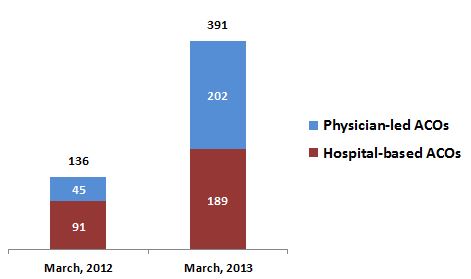
At a recent meeting of the American College of Physicians covered in MedPage Today, Neil Kirschner, PhD reported on the growth of ACOs. Dr. Kirschner is the ACP’s senior associate of regulatory and insurer affairs. He reported that in March, 2012, there were only 136 ACOs  that had ACO-style gain-sharing contracts with Medicare, a commercial payer

Physician-led ACOs now outnumber Hospital-based ACOs: Why this makes sense, and where our terminology breaks down. Read More »