Health Information Technology

Health Information Technology includes diverse systems used by health care providers, patients and health plans to capture, store, exchange, display and analyze health care data, and, more importantly, to facilitate, coordinate and improve health care processes.

U of Michigan study: Epic’s sepsis predictive model has “poor performance” due to low AUC, but reporting AUC is like building a bridge half way over a river. How to finish the job.

The Epic Sepsis Model (ESM) is a widely used proprietary predictive model that was described as having poor performance in a validation paper by Wong et al, citing low area under the ROC curve (AUC). But the evaluation failed to specify the intended protocol in which the ESM was intended to be used, and failed to include estimates of the outcomes of that protocol compared to usual care.

U of Michigan study: Epic’s sepsis predictive model has “poor performance” due to low AUC, but reporting AUC is like building a bridge half way over a river. How to finish the job. Read More »

Microsoft’s purchase of Nuance is not a bold move, despite the $16B price. My advice to Mr. Nadella is to avoid shiny objects and to not avoid process change.

As reported in a rambling article in the Wall Street Journal, Microsoft has announced the acquisition of Nuance Communications, Inc. The WSJ predicted, with its usual WSJ bravado, that this bold $16B move (paying 13 times Nuance’s 2020 revenue) will “kick start growth” in the “next big thing” — “healthcare.” But, this is not a

Microsoft’s purchase of Nuance is not a bold move, despite the $16B price. My advice to Mr. Nadella is to avoid shiny objects and to not avoid process change. Read More »

EMR event log study shows 6 hrs of use per day, but implicitly belittles the clinician’s cognitive effort and the EMR’s support

In a recent paper in the Annals of Family Medicine by Brian Arndt and colleagues at the University of Wisconsin, the authors described the results of an analysis of the user event logs of their Epic EMR.  The authors determined that primary care clinicians used the system nearly 6 hours per day out of an

EMR event log study shows 6 hrs of use per day, but implicitly belittles the clinician’s cognitive effort and the EMR’s support Read More »

How government surveillance of internet data relates to health care privacy and big data

This week, I accompanied my daughter and her elementary school classmates on a field trip to see the musical “The Sound of Music.”  To my daughter, it was a story about good vs. bad parenting.  But the context is 1930’s Austria, just as the Nazi regime is taking over.  The story illustrates how the battle

How government surveillance of internet data relates to health care privacy and big data Read More »

In the dust-up about “rebooting” the EHR meaningful use incentive program, “the Emperor has no clothes” has been the most interesting response.

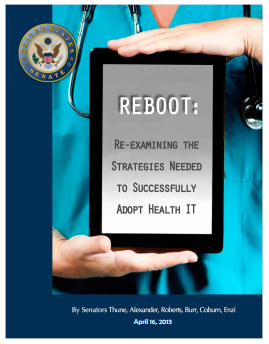
Last month, six Republican senators released a document entitled “Reboot: Reexamining the strategies needed to successfully adopt health IT.” The report asserts that the original goal of the $35 billion EHR meaningful use incentive program was to achieve “interoperability,” creating a “secure network in which hospitals and providers can share patient data nationwide.”  The report expresses concerns

In the dust-up about “rebooting” the EHR meaningful use incentive program, “the Emperor has no clothes” has been the most interesting response. Read More »

Compliance and Process Improvement are Opposites, no matter how hard you try to make compliance “meaningful”

I’m attending the HIMSS’13 conference in New Orleans this week, a huge assemblage of health care IT people and the bewilderingly diverse collection of technology vendors that sell to them.  The first meeting I attended was billed as a “town hall” meeting by the Federal Government’s “Office of the National Coordinator” (ONC).  The session was

Compliance and Process Improvement are Opposites, no matter how hard you try to make compliance “meaningful” Read More »

New HIT ROI lit review is a methodologic tour de force, but misses the point

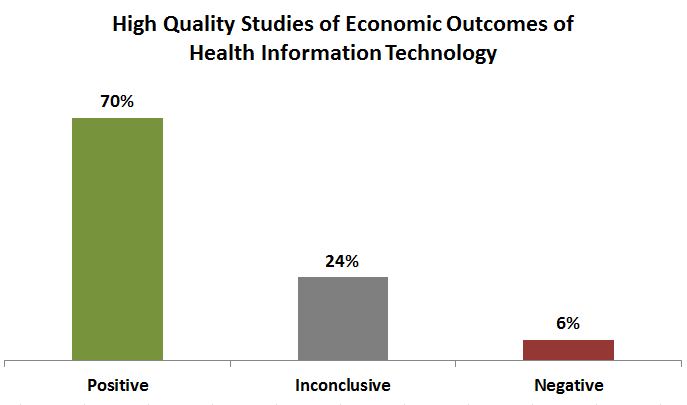
Recently, Jesdeep Bassi and Francis Lau of the University of Victoria (British Columbia) published in the Journal of the American Medical Informatics Association (JAMIA) another in a series of review articles that have been written in recent years to summarize the literature regarding the economic outcomes of investments in health information technology (HIT).  Such articles answer

New HIT ROI lit review is a methodologic tour de force, but misses the point Read More »

Big Data: A break-through, or just new terminology?

I don’t normally read the Harvard Business Review.  I find it a bit too cool.  Trying too hard to coin new words.  Over-simplifying complex issues.  Over-confidently setting expectations. Recently, Harvard Business Review sponsored a web-seminar entitled “Big Data: Can You Seize the Opportunity.”  Classic HBR.  Don’t challenge the premise.  Just challenge the audience to sign up. But,

Big Data: A break-through, or just new terminology? Read More »

The race in on between triple-aimers and hospital defenders

This week, Julie Creswell and Reed Abelson published an interesting piece in the New York Times about how the war between hospital chains puts doctors in a bind.  I think the article includes many relevant facts about the consolidation of the health care market.  But, I conceptualize the conflict a little differently. Here’s my take…

The race in on between triple-aimers and hospital defenders Read More »