Dr. Ward

Richard E. Ward, MD, MBA, CEO of Reward Health. Also physician, health care analytics and informatics innovator, husband, father, tenor & gradually improving swimmer

Klar 3: The necessity of re-qualifying the population to avoid regression-toward-the-mean bias in historical comparison groups

Ron Klar, MD, MPH is a health care consultant with a long history of involvement in federal health care policy and health plan innovation. He published a recent series of three posts regarding the draft rules for the Medicare Shared Savings Program (MSSP) in the Health Affairs Blog, an influential forum for debating health policy

Klar 3: The necessity of re-qualifying the population to avoid regression-toward-the-mean bias in historical comparison groups Read More »

Dr. Ward’s Slides from AMGA ACO Learning Collaborative, Chicago, July 14, 2011

Presentation entitled “Developing the Economic Model for Success” from day 2 of the American Medical Group Association’s Accountable Care Organization Learning Collaborative, at the Swissotel in Chicago.  Attended by approximately 60 leaders of AMGA member physician organizations and other interested parties. Full page PDF format. Hand-out PDF format.

Dr. Ward’s Slides from AMGA ACO Learning Collaborative, Chicago, July 14, 2011 Read More »

Identifying and Understanding Analysis Tricks: Regression Toward the Mean

Imagine that you are a new homeowner, shopping for insurance for your new house.  You live in an area prone to earthquakes, and you are not a big risk-taker.  You decide that you should have earthquake insurance.  You are on the web researching earthquake insurance policies. You come across the web site of Acme Insurance,

Identifying and Understanding Analysis Tricks: Regression Toward the Mean Read More »

Klar 2: The great attribution debates: Include specialists or not? Plurality or majority? Retrospective or prospective? Derived or declared?

Ron Klar, MD, MPH is a health care consultant with a long history of involvement in federal health care policy and health plan innovation.  He published a recent series of three posts (post 1, post 2, and post 3) regarding the draft rules of the Medicare Shared Savings Program (MSSP) in the Health Affairs Blog, an

Klar 2: The great attribution debates: Include specialists or not? Plurality or majority? Retrospective or prospective? Derived or declared? Read More »

Klar 1: Key points of agreement about changes needed for Medicare Shared Savings Program

Ron Klar, MD, MPH is a health care consultant with a long history of involvement in federal health care policy and health plan innovation.  He recently did an analysis of the draft rules for the Medicare Shared Savings Program (MSSP), the Medicare program that establishes accountable care organizations (ACOs).  Dr. Klar published his critique as

Klar 1: Key points of agreement about changes needed for Medicare Shared Savings Program Read More »

How to get a clearer picture of economic performance: Standard Cost and Payer Neutral Revenue

This morning, I read a set of slides published by the American Hospital Association (AHA) and the Health Research and Education Trust (HRET) called “Striving for Top Box: Hospitals Increasing Quality and Efficiency.” The report showcased the clinical integration and performance improvement efforts of three hospital-based health systems: Novant (North Carolina), Piedmont (Georgia) and Banner (Arizona).

How to get a clearer picture of economic performance: Standard Cost and Payer Neutral Revenue Read More »

What makes teams effective? (2) Achieving the Piranha Club state

Back in the mid-1990s, when I was working in the Center for Clinical Effectiveness at the Henry Ford Health System, I had the privilege and joy of being part of a team of smart, creative, passionate people working to transform health care.  The team included a core staff and an extended collection of collaborators from

What makes teams effective? (2) Achieving the Piranha Club state Read More »

What makes teams effective? (1) Not being too role-focused

I am a big fan of people in the fields of “usability” and “human factors.” These are engineering disciplines which have been applied to software engineering, more broadly to information technology and even more broadly to organizational effectiveness. Usability and human factors people focus on considering the mental and physical characteristics of users when designing

What makes teams effective? (1) Not being too role-focused Read More »

Why do other countries have different attitudes about Health Economics?

Wednesday morning, I attended a thought-provoking panel discussion entitled “Is Health Economics an Un-American Activity?” — a reference to the McCarthy-era Congressional committees that judged Hollywood movie directors and others considered to be communist sympathizers.  The panel presentation was part of the annual meeting of the International Society for Pharmacoeconomics and Outcomes Research (ISPOR) in

Why do other countries have different attitudes about Health Economics? Read More »

In the battle between Randomized Clinical Trialists and Observational Studies Advocates, don’t forget the Modelers

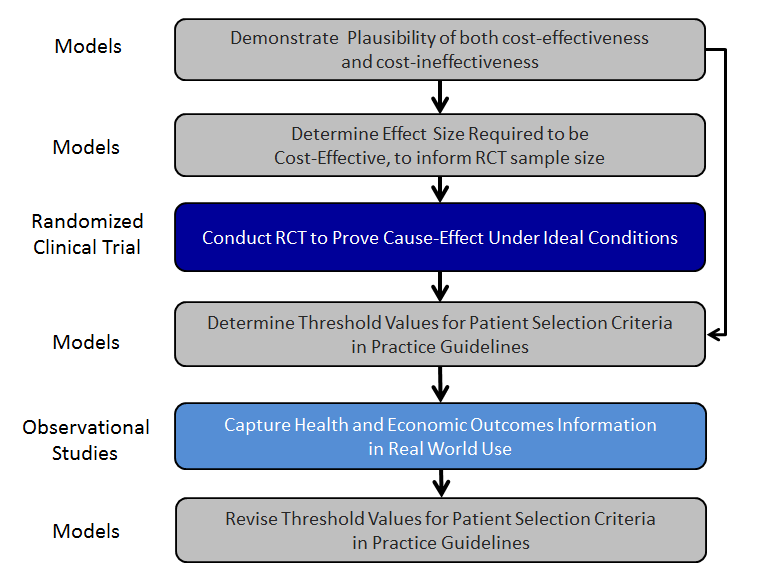
This week, I’m attending the annual meeting of the International Society for Pharmacoeconomics and Outcomes Research (ISPOR) in Baltimore.  Yesterday evening, I attended an interesting “smack-down” presentation between advocates for Randomized Clinical Trials (RCTs) vs. advocates for Observational Research.  The session was packed with hundreds of people.  In one corner was Michael Lauer, MD, the

In the battle between Randomized Clinical Trialists and Observational Studies Advocates, don’t forget the Modelers Read More »