Dr. Ward

Richard E. Ward, MD, MBA, CEO of Reward Health. Also physician, health care analytics and informatics innovator, husband, father, tenor & gradually improving swimmer

Hans Rosling illustrates how to tell compelling stories with data

Hans Rosling is a doctor and researcher that noticed that the statistics people at the World Health Organization had compiled a rich database of information regarding the health and well-being of people in different countries over long periods of time. But, he also noticed that they were wasting this data by producing boring charts and

Hans Rosling illustrates how to tell compelling stories with data Read More »

Video of ACO Breakfast at HIMSS’11 Meeting

The following is the link to a hand-held video from the “ACO Breakfast” event on February 21, 2011 at the annual Health Information Management Systems Society convention in Orlando. http://www.healthcareitnews.com/video/aco-breakfast-himss11 The panel discussion was kicked off by Eric Dishman, Director of Health Innovation for Intel, and featured: Aneesh Chopra, the Chief Technology Officer of the

Video of ACO Breakfast at HIMSS’11 Meeting Read More »

Learning from Manufacturers about Culture and Technology: The Case of PLM Systems

Product Lifecycle Management (PLM) systems are software tools that are used by product manufacturing companies to support the entire lifecycle of ideation, business planning, requirements, design, manufacturing, launch, and eventual retirement of products. They are interesting to me for two reasons: (1) they are relevant to the development of software products, and (2) they share

Learning from Manufacturers about Culture and Technology: The Case of PLM Systems Read More »

What are agent-based models and how do they relate to ACOs?

Agent-based Modeling (ABM) is a type of computational simulation that involves the creation, inside a computer’s memory, of a collection of objects that are programmed to mimic the behavior of people, companies, countries or anything else that constitutes the “agents” that interact and change over time as part of a complex system. ABM has been

What are agent-based models and how do they relate to ACOs? Read More »

Reference for Joint Principles of the Patient Centered Medical Home, 2007

Here is the original reference to the February, 2007, 3-page consensus document that describes the Joint Principles of the Patient Centered Medical Home.  It was created by the four professional societies that are focused on primary care: American Academy of Family Physicians (AAFP), American Academy of Pediatrics (AAP), American College of Physicians (ACP), and American Osteopathic Association (AOA). Very

Reference for Joint Principles of the Patient Centered Medical Home, 2007 Read More »

Harold Miller’s Paper: How to Create Accountable Care Organizations

This is probably the single most useful reference regarding Accountable Care Organizations, outlining alternative ways of conceptualizing them and giving a balanced explanation of the pros and cons of alternative models, including structure and reimbursement.  David Share, MD, from BCBSM was involved, and the document uses BCBSM’s Physician Group Incentive Program as a case study.

Harold Miller’s Paper: How to Create Accountable Care Organizations Read More »

The Smoking Intervention Program, a Provider-based Care Management Process

Smoking cessation is an important public health concern, and has been the subject of a recent Agency for Health Care Policy and Research (AHCPR) guideline, as well as a HEDIS measure.   A point prevalence study conducted with the Henry Ford Health System found a 27.4% prevalence of smoking, and an additional 38.6% former smokers. The

The Smoking Intervention Program, a Provider-based Care Management Process Read More »

Using Eddy’s Explicit Method to Develop Practice Guidelines for Mammography in the 40-49 Age Group

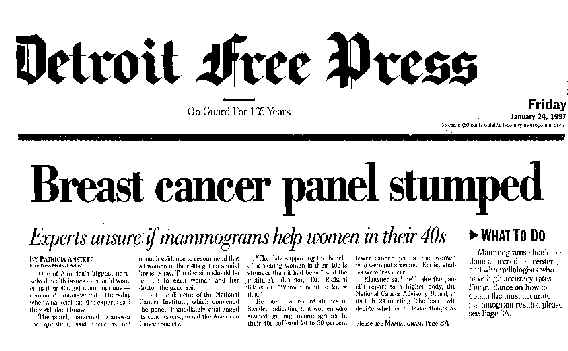
Note that the following write-up is now almost 20 years old!  (How did that happen?)  Amazingly, the debate about the role and frequency of mammography in the 40-49 age group has raged on the entire time since then.  This case study demonstrates the real-world use of the “explicit method” proposed by one of my “health

Using Eddy’s Explicit Method to Develop Practice Guidelines for Mammography in the 40-49 Age Group Read More »

Improving Total Hip Replacement Surgery

Background Joint replacement is a costly and frequently performed inpatient procedure.  In 1995, Henry Ford Hospital carried out 280 total hip replacements and 225 total knee replacements.  To decrease unnecessary inpatient utilization and enhance functional outcomes of joint replacement surgery, Henry Ford Hospital established a multi-disciplinary improvement team, including representatives from Orthopedic Surgery, Physical Therapy,

Improving Total Hip Replacement Surgery Read More »