Accountable Care Organizations (ACOs)

An accountable care organization (ACO) is type of managed care organization in which physicians, hospitals and other providers takes responsibility for the health and wellness of a population of patients, including responsibility for high quality, appropriateness, and efficiency of the care provided.

2 min video of Harold Miller saying hospitals need to be offered a “glide path” to handle revenue reduction anticipated from new payment models

In this 2 minute video, Harold Miller, Executive Director, Center for Healthcare Quality & Payment Reform,talks about the changes that hospitals will face during the transition to new payment models. His remarks were part of the Massachusetts Medical Society’s program, “A Path to Accountable Care Organizations: How Do We Get There From Here?”, held on
2 min video of Harold Miller saying hospitals need to be offered a “glide path” to handle revenue reduction anticipated from new payment models Read More »

How do we reduce errors in software and data analysis? Culture of Accountability vs. Culture of Learning

A young colleague recently wrote to me complaining of frustration from having to deal with a high rate of errors in software development and data analysis.  Any time you are innovating in a knowledge-intensive field such as health care, you will need to develop new software and analyze data in new ways.  Errors will inevitably

How do we reduce errors in software and data analysis? Culture of Accountability vs. Culture of Learning Read More »

What can we learn from the managed care backlash of the 1990s? Can we avoid an ACO backlash?

Advocates of “accountable care organizations” (ACOs) are careful to avoid the terminology of “managed care,” which is widely viewed as a failed model from the 1980s and 1990s.  But, there are obvious similarities between ACOs and managed care.  Both involve an organization taking responsibility for the quality and cost of care for a defined population.

What can we learn from the managed care backlash of the 1990s? Can we avoid an ACO backlash? Read More »

Mayo and Cleveland Clinic are becoming franchisers. Maybe they should focus on primary care.

As described in a recent article in American Medical News, the Mayo Clinic and the Cleveland Clinic are both independently offering medium to large groups of specialist physicians an opportunity to use their esteemed brand names and a variety of other resources formerly only available to employed physicians.  In return, the group has to pay

Mayo and Cleveland Clinic are becoming franchisers. Maybe they should focus on primary care. Read More »

CMS Innovations Center announces new Medicare Bundled Payments Initiative. I predict it will be popular.

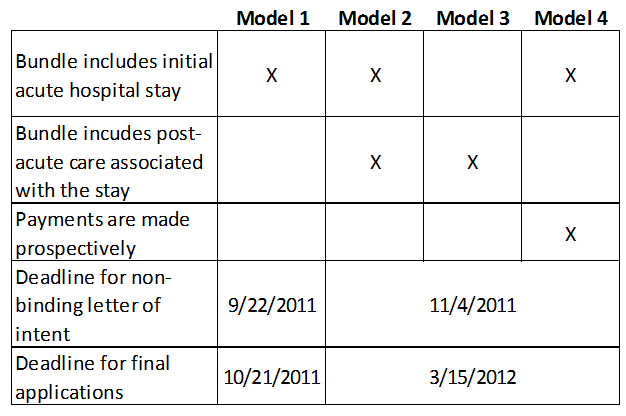
On top of the Medicare Shared Savings Program (the original ACO initiative) and the Pioneer ACO Program, CMS is now adding four more optional approaches for providers to get reimbursed for Medicare services.  The new models all involve bundled payments, where a single negotiated payment covers all professional and facility services for a particular type

CMS Innovations Center announces new Medicare Bundled Payments Initiative. I predict it will be popular. Read More »

Hospitalists have been focused on reducing hospital length of stay, but not so much on smooth transitions to ambulatory care

A new study published in the  Annals of Internal Medicine compared the economic outcomes of hospital episodes managed by hospitalists to those managed by the patients’ primary care physicians in a Medicare population. Previous studies focused only on the cost of the hospital stay itself, and showed that hospitalists were able to reduce length of stay

Hospitalists have been focused on reducing hospital length of stay, but not so much on smooth transitions to ambulatory care Read More »

Reports of the death of Cost-Effectiveness Analysis in the U.S. may have been exaggerated: The ongoing case of Mammography

Guidelines for the use of mammograms to screen for breast cancer have been the topic of one of the fiercest and longest-running debates in medicine.  Back in the early 1990s, I participated in that debate as the leader of a guideline development team at the Henry Ford Health System.  We developed one of the earliest

Reports of the death of Cost-Effectiveness Analysis in the U.S. may have been exaggerated: The ongoing case of Mammography Read More »

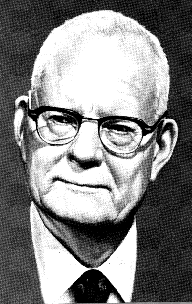
Health Care Heroes: Wilmer Rutt, MD – Adapting the R&D Concept to Health Care Provider Organizations

This morning, I read the results from a clinical trial of ovarian cancer screening in JAMA.  The trial showed that ovarian cancer screening was not effective in saving lives.  I was interested in the article because I was one of the investigators in that trial, which began in the early 1990s.  Henry Ford Health System

Health Care Heroes: Wilmer Rutt, MD – Adapting the R&D Concept to Health Care Provider Organizations Read More »

Klar 4: Why is it important for CMS to Share Claims Data with ACOs?

Ron Klar, MD, MPH is a health care consultant with a long history of involvement in federal health care policy and health plan innovation. He published a recent series of three posts regarding the draft rules for the Medicare Shared Savings Program (MSSP) in the Health Affairs Blog, an influential forum for debating health policy issues.

Klar 4: Why is it important for CMS to Share Claims Data with ACOs? Read More »

Klar 3: The necessity of re-qualifying the population to avoid regression-toward-the-mean bias in historical comparison groups

Ron Klar, MD, MPH is a health care consultant with a long history of involvement in federal health care policy and health plan innovation. He published a recent series of three posts regarding the draft rules for the Medicare Shared Savings Program (MSSP) in the Health Affairs Blog, an influential forum for debating health policy

Klar 3: The necessity of re-qualifying the population to avoid regression-toward-the-mean bias in historical comparison groups Read More »